
In this article
Preparing for Coinbase requires checking which version of its engineering interview guidance you are reading. Its July 2026 update describes an AI-assisted process built around existing repositories and engineering judgment. This guide separates that announcement from older advice, then offers a preparation plan you can adapt to the round your recruiter confirms.
What Coinbase actually announced
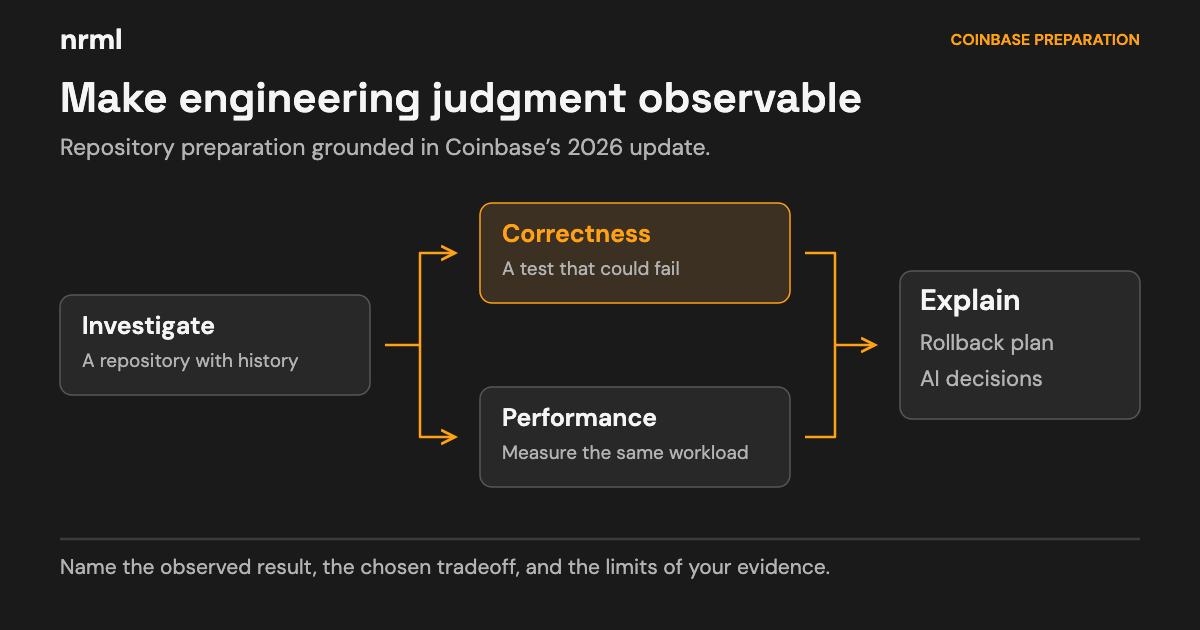
Coinbase’s July 13, 2026 account traces a frontend pilot in the second half of 2025, a backend expansion in January 2026, and engineering-wide AI evaluation signals in March. Backend exercises use custom repositories for debugging, correctness and performance review, and rollback reasoning. The published fluency dimensions cover effective tool use, appropriate application, and understanding limitations. Coinbase’s 2026 interview update.
The same post marks repository coding/debugging and leadership/behavioral evaluation as live. It labels AI-assisted system design as early testing, with a pilot still ahead. Behavioral discussions include actual AI use at work. Those are the article’s July statuses; they do not establish the exact format of your October interview. See the stated rollout status.
The preparation plan below is nrml’s recommendation. It is built around work you can inspect and explain in a repository you are allowed to use. None of the suggested activities is a released Coinbase question or a prediction of your assessment.
Read older interview guides by date
Coinbase’s September 2021 engineering guide already emphasized maintainable code, testing, debugging method, and communication. Its examples and round timings belong to that older process. The continuity is useful: readable, defensible work mattered before AI assistance. The old schedule is less useful as a promise about a redesigned loop. Coinbase’s 2021 engineering guide.
The March 2024 general hiring overview describes six stages and role-dependent assessments. It predates the engineering redesign too. Read it for historical context, then ask which stages still apply to your role. Combining every stage from every published guide would create an interview sequence that no single source describes. Coinbase’s 2024 hiring overview.
Make a short preparation note with three columns: confirmed in your invitation, described in dated public guidance, and still unknown. Put the interview length, permitted tools, language, setup requirements, and expected deliverable in that note. Resolve the unknowns before spending a weekend preparing for the wrong format.
Prepare with a repository that has history
Choose a small open-source project or a personal project with existing tests and a resolved bug. Prefer something you can run locally without production accounts. A repository with a real issue, a change, and a regression test gives you an outcome to investigate. You can later compare your reasoning with the maintainer’s solution.
Start at the revision before the fix. Read the issue and run the relevant tests before viewing the patch. Locate the public entry point, the state it changes, and the assertion that should observe the reported failure. Write down the behavior you expect before asking an assistant to explain the implementation.
Then allow AI to help you locate candidates or propose a repair. Keep your initial notes. Comparing the assistant’s explanation with your own trace reveals whether it found a missing dependency, repeated an assumption, or introduced a new one. The useful result is a defensible investigation, even if your final patch differs from the maintainer’s.
Separate a passing test from a justified change
Before accepting a generated patch, identify the observation that would prove it wrong. If a bug concerns an unauthorized update, inspect stored state as well as the returned error. If it concerns repeated work, count the underlying operation. If it concerns ordering, control the order explicitly. Choose the observation from the reported behavior, rather than copying the implementation into a test.
Run the regression against the original revision and the proposed repair. Check that it fails for the relevant reason before the change. A test that passes on both revisions may still check something useful, but it does not demonstrate this repair. Record the command and the difference you observed.
Inspect the final diff for changes outside the investigation. A new dependency, altered response shape, or rewritten neighboring function creates additional claims to justify. During rehearsal, explain which changes are essential to the fix and which you would remove or submit separately. This is a concrete way to practice reviewing an assistant’s output.
Give performance and rollback claims a concrete meaning
For a performance change, first name the resource you are trying to reduce: database calls, allocations, network requests, or elapsed time under a specified workload. A shorter function does not establish an improvement. Use the same input and environment for the comparison, repeat noisy measurements, and report the limits of a local result.
For release reasoning, draw the boundary between reverting code and undoing effects. Reverting a worker cannot retract an email it already sent. Restoring an earlier binary may leave a database column, cached representation, or queued message created by the newer version. Pick the effects that actually exist in your practice repository and explain what the previous version can still read.
You do not need to invent a production deployment for a local exercise. A precise answer may be that you verified compatibility with an old fixture but did not test mixed versions running concurrently. Keep the next verification step specific enough that another engineer could perform it.
Bring one project you can explain in detail
Prepare a real example of a decision you made while using AI. Choose a change small enough to discuss completely: what needed to happen, what you delegated, what you inspected, and what evidence supported the result. A modest repair with a clear explanation is easier to defend than an ambitious project whose important decisions you cannot reconstruct.
Use your own notes or permitted artifacts to distinguish your contribution from teammates’ work and generated output. If you cannot substantiate a speedup, describe the workflow change without inventing a percentage. If a suggestion was useful, explain why; if it was rejected, identify the requirement it violated. Our guide to explaining AI-assisted work develops this preparation method.
Rehearse a follow-up about a changed requirement. Explain what part of your decision would survive and what you would revisit. That makes the conversation about your understanding of the work rather than your ability to recite the project summary.
Confirm the conditions of your particular round
Send the recruiter a compact set of practical questions. You need enough information to arrive ready to work; you do not need confidential questions or a private scoring rubric. Save the reply alongside the invitation so that preparation follows the instructions for your assessment.
Will I work in a supplied repository, start a project, or discuss an existing design?
Which AI tools and accounts are permitted in this round, and is the same permission valid for every stage?
What language, runtime, editor, and screen-sharing setup should I prepare?
How much time is allocated, and what should I demonstrate before the round ends?
Questions candidates should resolve before preparing
Should I assume AI is allowed in system design? Get confirmation for that round. A published direction of travel does not establish your assessment’s rules.
Does this guide contain Coinbase interview questions? No. The repository rehearsal and review method are nrml preparation advice. Use public issues or your own work to practice without treating them as a question bank.
What should I have ready at the end of preparation? A working environment, a repository investigation you can reproduce, a project decision you can defend, and the recruiter’s instructions. Use the company interview directory to compare other employers’ published policies without assuming their rules transfer to Coinbase.
Sources & editorial notes
This article was authored with AI using primary-source research and an automated technical review. It has not been reviewed by a human. Code examples are illustrative; run and verify them in your own environment.
- Coinbase: Interviewing Engineers in the AI Era
Published July 13, 2026; checked October 15, 2026. Primary account of the redesign and the different rollout stages, not a guarantee of an individual interview format.
- Coinbase: How Coinbase interviews for engineering roles
Published September 7, 2021; checked October 15, 2026. Historical evidence of engineering expectations; older round counts and timings are not presented as current.
- Coinbase: How to interview at Coinbase
Published March 19, 2024; checked October 15, 2026. Historical general hiring overview, distinguished from the later engineering-specific update.
Put the reading into practice
Work through an existing repository, review AI suggestions, and test the decisions behind your changes.
Explore practice problems